Blackbox turns a recorded meeting into structured minutes and — for any change that was actually discussed — a draft requirement with acceptance criteria, every line traceable to a timestamp in the recording. I built it for the way a lot of teams actually work: the requirement starts life in a call, and someone has to turn it into a tracked work item afterward.
It runs where the recording lives; nothing is filed anywhere automatically. The output is a clipboard block a reviewer reads before it becomes a work item.
The Problem
A lot of requirements start life in a meeting — a call where a change gets talked through, half-decided, and left with loose ends. Turning that into a clean work item afterward is slow, and doing it from memory loses the details that matter.
The obvious fix — “feed the transcript to an LLM and ask for requirements” — has a trap in it. Ask a model for acceptance criteria and it will produce acceptance criteria, whether or not the meeting supplied them. A confident, well-formatted, invented requirement is worse than no tool at all, because it reads like work product. That failure mode is the whole design problem.
The Principle
Blackbox is a drafting assistant with citations, not an automation. Two rules fall out of that:
- Every acceptance criterion carries the timestamp span it came from. If the model can’t point to where in the recording a behavior was stated, it isn’t allowed to write the criterion.
- Ambiguity is surfaced, not smoothed. Anything the meeting left open goes into an unresolved questions block instead of getting filled with a plausible guess. Fewer, better-supported items beat comprehensive coverage.
Nothing runs through the model until the speakers have real names, and nothing is trusted without review.
What I Built
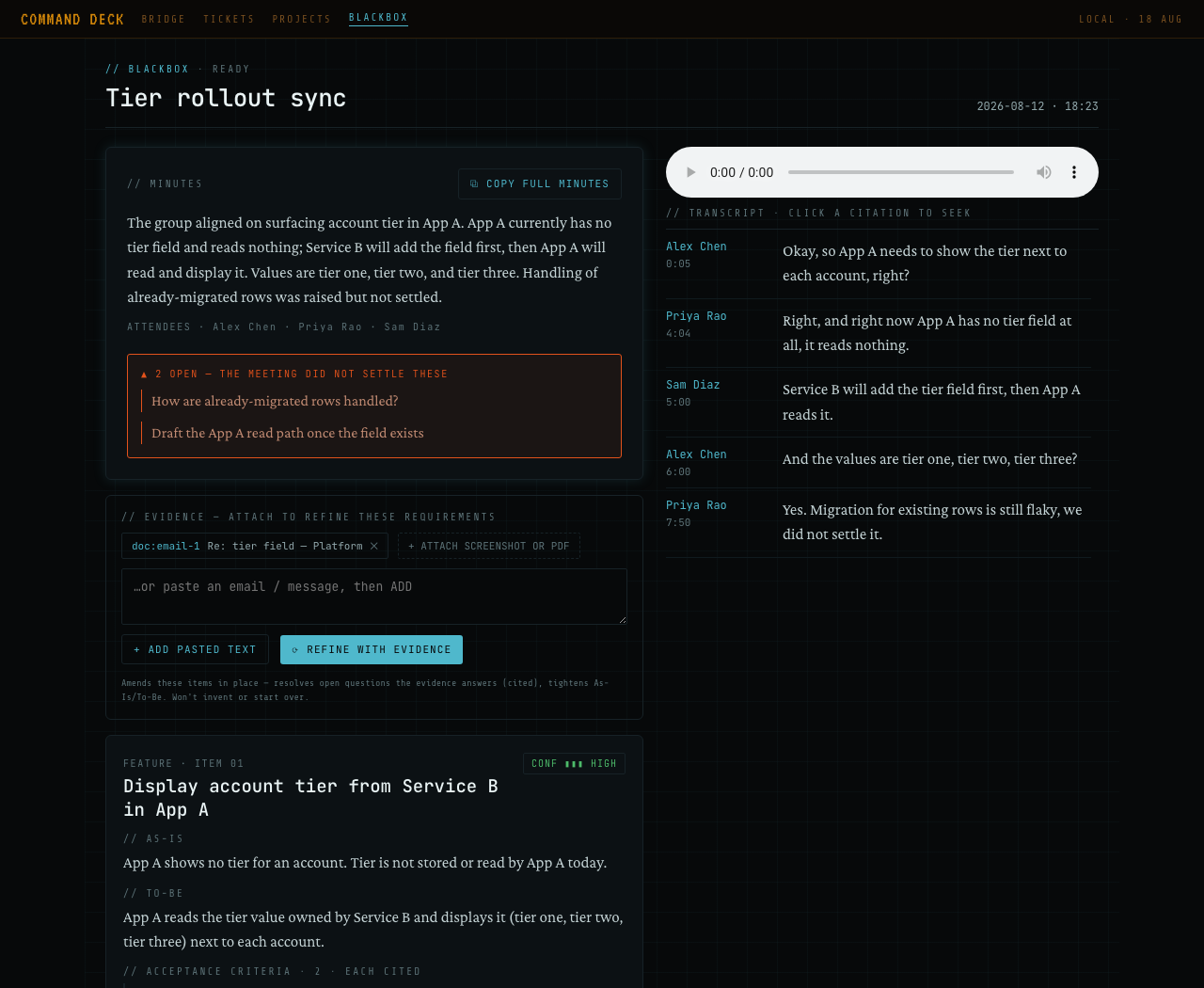 The Review screen. Each criterion cites an audio span; clicking it seeks the player and lights the transcript. Unresolved questions get their own block — they’re the point, not a footnote.
A single pipeline, each stage honest about where it is:
- Ingest & transcribe. Chunked browser upload for large recordings,
ffmpegto strip and downmix the audio, and ElevenLabs Scribe for a diarized, word-timestamped transcript. The raw transcript is the source of truth every citation resolves against. - Name the speakers. A hard gate: the user maps each detected voice to a real name (with playable sample clips), and a per-meeting-title roster pre-fills the guesses next time. “speaker_2 will own the migration” is not a usable action item.
- Two passes, on purpose. Minutes want compression; requirements want precision — so they’re separate calls with separate prompts. Pass A writes the minutes; Pass B extracts draft requirements as As-Is / To-Be with Given/When/Then acceptance criteria, each cited, and every unsettled thing pushed to unresolved questions.
- Review, don’t file. A split pane — items on the left, transcript and audio on the right — where clicking any citation scrubs the recording to that moment. Every item copies out as a work-item-shaped block for review before it goes anywhere.
Three refinements came out of real, messy meetings:
- Scope. Real meetings are cross-team — two groups each with a change to make. You only want the work item for your system, so you tell it which systems you own. Another team’s prerequisite becomes a cited dependency on your item, never its own work item.
- Supplements. The email or spec PDF that carries the real detail can be attached and fed to the passes as cited evidence — a criterion can cite
doc:email-1alongside the audio. More evidence, still no invention; a supplement that contradicts the meeting becomes an open question. - Refine in place. When evidence arrives after the fact, adding it updates the existing requirements — resolving an open question into a cited criterion — rather than regenerating them from scratch.
Under the Hood
- Traceability as a data model. Each criterion’s
sourceis a tagged reference — an audio span or a document locator — so a requirement can be backed by the recording and by an attached PDF in the same list, and the UI seeks the right thing for each. - Validation on receipt. Pass B is re-checked before it’s shown: malformed JSON, a citation outside the recording, or a criterion with no source triggers one repair round; a second failure flags the whole item as unverified rather than quietly trusting it.
- Multimodal without a new stack. Images and PDFs ride into the passes as native content blocks, so a screenshot or a spec doc is read directly — no separate OCR pipeline.
- A UI with a point of view. It reads as an instrument, not a chat window — cold cyan traces on graph-ruled graphite, one loud colour reserved for the gaps the meeting left open. Confidence is a quiet three-cell meter, so “low” is legible without being an alarm.
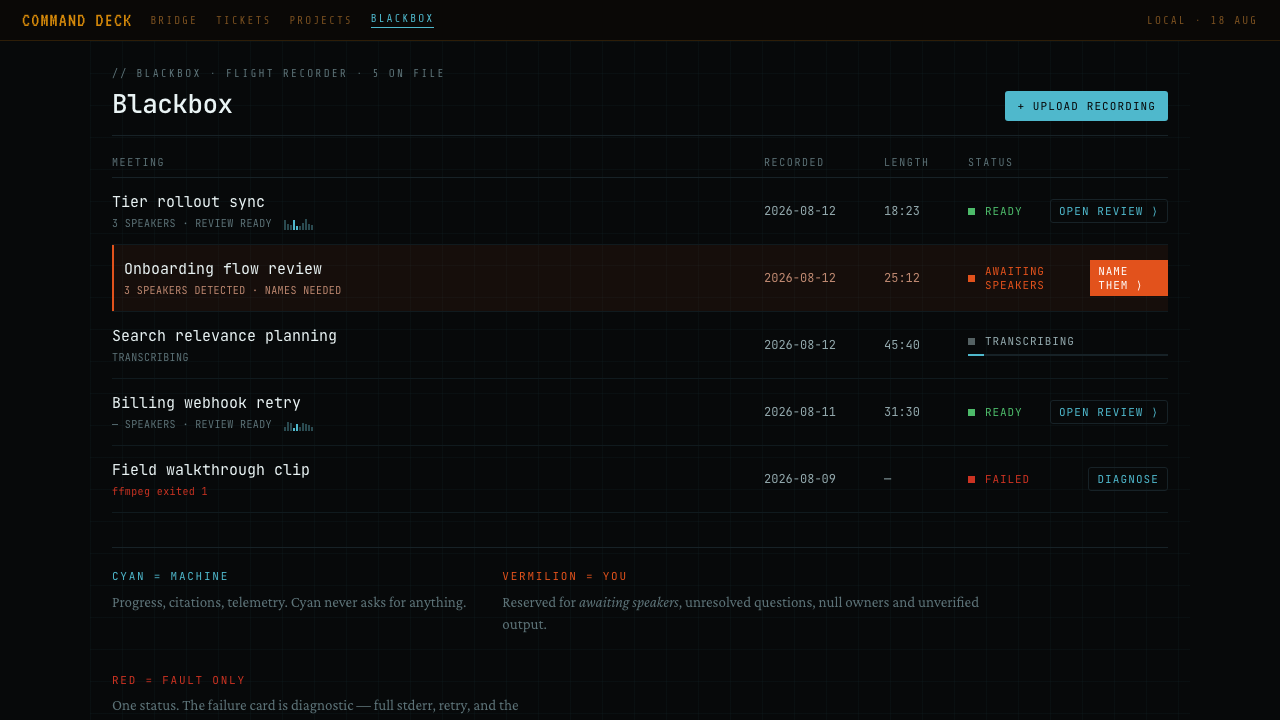 The inbox. Passive states show a real number (“22:10 of 45:40”); the naming gate is the one row that asks something of you, and it’s the one that looks it.
Stack
- Python + Flask
- SQLite
- ffmpeg / ffprobe
- ElevenLabs Scribe
- Claude (Anthropic)
- Vanilla JS + CodeMirror-free, zero build
- Runs local
It runs wherever the meeting audio lives — a laptop or a locked-down box — because processing recordings shouldn’t mean shipping them off to a service. Honest limits are the feature: it drafts less than a naïve tool would, and everything it drafts can be read straight against the tape.
This one is built and running. If your team turns meetings — or messages, or documents — into work, and you'd want a version of it, tell me what you're trying to do. It goes straight to my inbox: no CRM, no middleman.